AEP Adoption & Activation
Why AEP Migrations Fail
The platform is not the problem. The approach is.


Most AEP migrations fail for one reason, no architectural leader owns the full platform. When organizations attempt migrations without clear decision authority, three predictable failure patterns appear. Teams replicate legacy data models instead of designing for business outcomes. Data engineering groups dump entire data warehouses into AEP instead of curating data for activation. Organizations also migrate broken data foundations forward and expect the new platform to solve problems that were never platform problems.
These patterns are avoidable. One Fortune 100 telecom provider moved from two years of stalled RTCDP adoption to live activation in two months after assigning architectural leadership across the full stack. The technology did not change, the governance model did. Before starting any AEP migration, organizations should answer one question. Who owns architectural decisions across the entire platform?
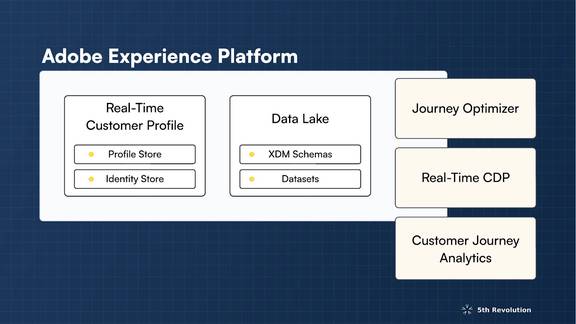
Adobe Experience Platform architecture showing the data foundation (Real-Time Customer Profile, Data Lake) and platform services (Journey Optimizer, Real-Time CDP, Customer Journey Analytics)
AEP migrations don't fail because of the technology. They fail because organizations attempt them without clear architectural leadership across the full platform. That single gap produces every common failure pattern: legacy replication, data warehouse dumps, and migrating broken foundations. It is avoidable.
Adobe Experience Platform (AEP) is the most capable customer data platform in the enterprise market. It is also the most misunderstood.
Having led AEP adoption programs for Fortune 100 brands at Adobe, we have seen the same migration story play out across industries: telecom, financial services, retail, travel. The technology is not the problem. AEP delivers exactly what it promises. The failures happen upstream, at the strategic and organizational level, before a single schema is designed or a single dataset is ingested.
One root cause accounts for the vast majority of failed AEP migrations. And it is entirely avoidable.
The Architectural Leadership Gap
Enterprises adopt AEP and assign shared ownership across multiple teams. The analytics team owns CJA. The marketing operations team owns campaign activation. The data engineering team owns ingestion. IT manages access and infrastructure. Everyone has a piece. Nobody owns the whole.
This is not an org chart problem. It is a lack of architectural leadership, on both the business side and the technology side.
AEP is a unified platform that can unlock and operationalize a holistic customer experience with precision and high visibility into the journey. But that power requires someone to wield it. Without a principal architect or architecture team that understands the platform end to end and can make binding decisions, the result is churn.
Schema design decisions stall because three teams have conflicting requirements and no one has the authority to resolve them. Identity strategy gets implemented piecemeal because each team configures their own namespace conventions. Governance never materializes because nobody is accountable for naming standards, lifecycle rules, or access controls across the platform. Segments pile up with 80 to 90 percent dormancy rates because there is no ownership over what gets created or retired.
Teams duplicate effort. Conflicting patterns accumulate. And the platform becomes a collection of disconnected implementations rather than a unified architecture.
Platform ownership is the difference between AEP as a unified architecture and AEP as an expensive collection of disconnected tools.
This leadership gap is the root cause, and it produces three specific failure patterns.
Legacy replication instead of outcome-driven design
Without architectural leadership defining the target state, teams default to replicating what they already have. They look at whatever system AEP is replacing and ask: "How do we recreate this in the new platform?" That question sounds reasonable. It is the wrong question entirely.
A company running email campaigns through a legacy system has a data model built around that system's constraints. When AEP enters the picture, the instinct is to recreate that model in AEP's Experience Data Model (XDM). Same fields. Same structure. Same logic. New platform. The result is a next-generation platform running a last-generation architecture.
AEP is not a replacement for your email system, your analytics tool, or your campaign platform. It is a unified data foundation that powers all of them. The data model should start with business outcomes. What experiences do we want to deliver? What customer behaviors do we need to understand? What decisions do marketers need to make in real time?
When teams start from the old system's data model instead of the business goal, they end up with schemas that technically work but cannot support cross-channel activation through Real-Time CDP (RTCDP), orchestrated journeys through Adobe Journey Optimizer (AJO), or unified analytics through Customer Journey Analytics (CJA). They have migrated their data without migrating their thinking.
A principal architect would catch this on day one and reframe the conversation from "replicate what we have" to "design for what we need."
Data warehouse dumps instead of activation curation
The second pattern comes from data teams, and it is equally destructive. Enterprises with mature data infrastructure have an Enterprise Data Warehouse (EDW) that houses years of operational data. When AEP arrives, the instinct is to bring all of it into the platform. Every table. Every field. Every historical record.
This fundamentally misunderstands what AEP is designed to do.
Your EDW is a system of record. Its job is to house operational data for years and serve as the canonical source of truth. AEP is a system of activation. It excels at collecting event data, stitching identities together, and responding with personalized experiences in real time. Whether that is onsite personalization, an SMS, a push notification, or triggering an outbound call, AEP's strength is turning customer signals into action.
These are different purposes, and they require different data strategies.
When you dump your entire EDW into AEP, storage costs escalate on data nobody activates. Profile quality degrades as irrelevant operational records pollute customer profiles. Segmentation becomes noisy as marketers build audiences against datasets that were never designed for their use cases.
The right approach is deliberate curation. Bring in the customer attributes that drive segmentation. Ingest the behavioral events that trigger journeys. Connect the identity signals that enable cross-channel recognition. Leave the rest in your EDW where it belongs. AEP and your data warehouse complement each other when each platform serves its purpose. They become redundant and expensive when one tries to do the other's job.
We have seen enterprises ingest hundreds of datasets into AEP and activate fewer than ten. That is not a data foundation. That is a data dump on an expensive platform.
An architectural owner would establish that boundary before the first dataset is ingested.
Migrating broken foundations instead of stabilizing first
The third pattern is the most expensive because it compounds every other problem. Organizations have been running Adobe Analytics, Adobe Target, and other traditional applications for years on a data foundation that was never properly maintained. The data layer is outdated. Tagging is incomplete or inconsistent. Data collection across the customer journey has gaps that everyone has learned to work around rather than fix.
When AEP enters the picture, the assumption is that the new platform will solve these problems. It will not. You cannot pile new technology on a broken foundation and expect it to fix everything.
RTCDP, CJA, AJO, and every other service built on the platform depends on the quality of data flowing into it. If your data layer does not accurately represent how customers interact with your properties, that same incomplete picture carries straight through to AEP. If your tagging strategy has been strung along for years with patches and workarounds, those gaps do not disappear with a migration. They get more expensive. The traditional applications were tolerant of a messy foundation because teams built workarounds over time. AEP is not that forgiving.
We see this across industries. Organizations that have underinvested in their data foundation for years suddenly expect a platform migration or AI to solve problems that are not platform problems. They are data collection problems. AI is only as good as the data it operates on, and no amount of new technology fixes data that was never captured correctly in the first place.
An architectural owner would audit and stabilize the data foundation before designing the migration path. They would identify what is broken in the data layer, what is missing from the tagging strategy, and what needs to change in how data is collected across the customer journey. Stabilize first, then migrate. The organizations that skip this step end up paying twice: once for the migration and again to fix the foundation they should have addressed before they started.
What It Looks Like When It Works
A Fortune 100 telecom provider had licensed Real-Time CDP two years before we were brought in. In that time, zero activation had occurred. No event data streaming into the platform. No audience segmentation. No personalization. The platform sat unused while the licensing costs continued.
The problem was not the technology. It was the absence of architectural leadership. Multiple teams had a stake in the platform. None had the authority to drive it forward.
We stepped in as the architectural authority. We established clear ownership over data model design, identity strategy, and activation architecture. We designed the data foundation for activation, not replication. We made the binding decisions that had stalled across teams for two years.
Within two months, event data was streaming into the platform. Edge segmentation was running in real time. Personalized experiences were being delivered across channels. The platform was doing exactly what it was built to do.
Two years of stalled adoption. Two months to activation. The difference was not the technology. It was architectural leadership.
Before You Start Your AEP Migration
AEP migrations fail when organizations attempt them without clear architectural leadership. That single gap produces every downstream failure: legacy replication that constrains a next-generation platform, data warehouse dumps that bury activation capabilities, broken foundations that get migrated instead of fixed, and teams that pull in different directions.
The enterprises that succeed designate a principal architect or a small architecture team that holds decision authority across the full stack: data model design, identity strategy, governance frameworks, cross-product integration patterns, and activation architecture. This group does not own every individual workstream, but they own the architectural decisions that affect the platform as a whole.
Before you begin, ask one question. Who owns architectural decisions across the full platform? If the answer is "multiple teams" or "it depends," designate clear leadership before you start. Every other decision flows from this one. Get it right and the rest follows. Skip it and you are two years into a stalled migration wondering what went wrong.